
Shaheed Udham Singh’s Martyrdom Day 2026: Honouring the Revolutionary Who Avenged the Jallianwala Bagh Massacre
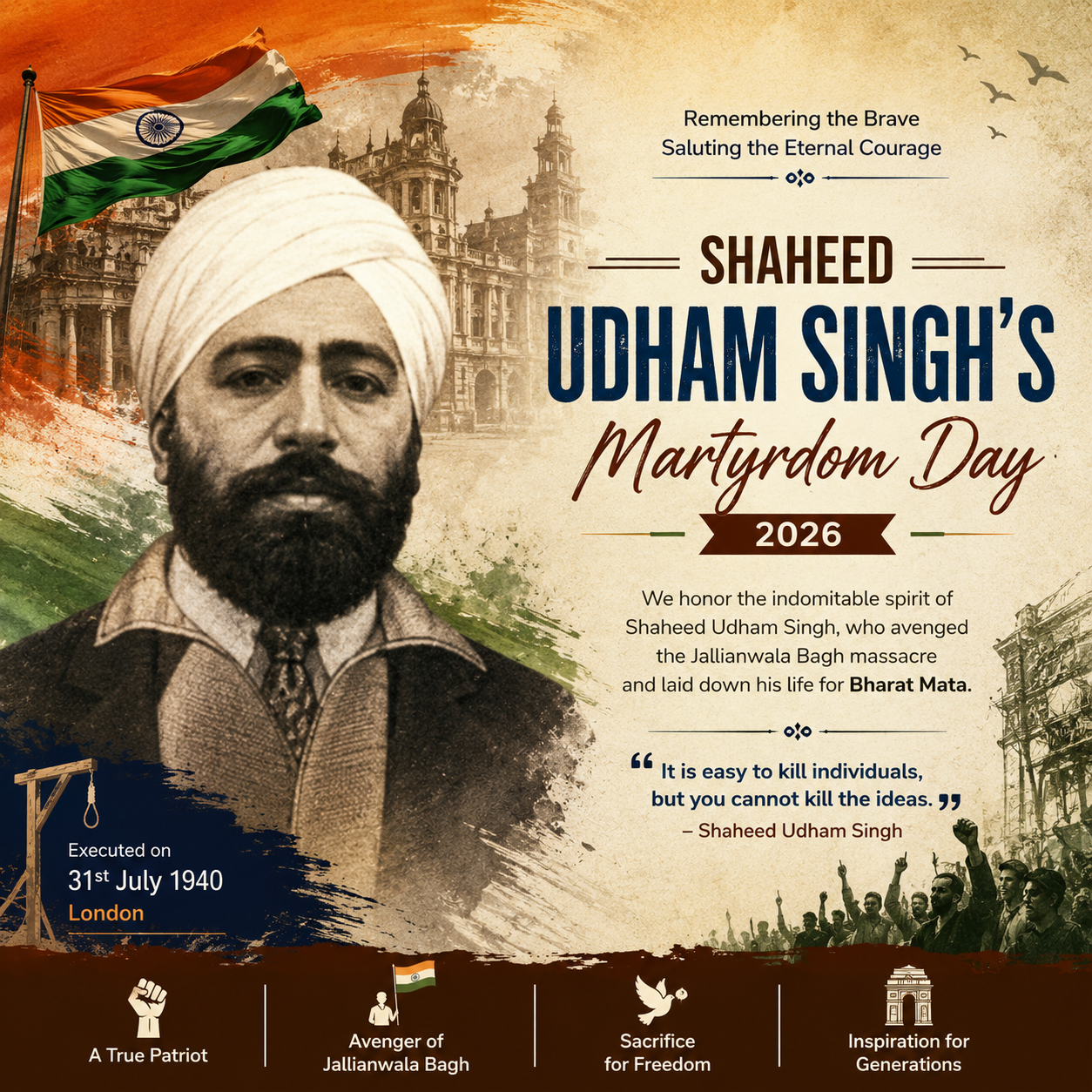
Every year on 31 July, India observes Shaheed Udham Singh’s Martyrdom Day to pay tribute to one of the nation’s bravest freedom fighters. Udham Singh dedicated his life to seeking justice for the innocent victims of the Jallianwala Bagh Massacre of 1919, an event that left an unforgettable mark on India’s struggle for independence.
His courage, determination, and unwavering patriotism continue to inspire generations of Indians. Martyrdom Day is an opportunity to remember his sacrifice and reaffirm our commitment to the values of freedom, justice, and national unity.
Who Was Shaheed Udham Singh?
Shaheed Udham Singh was born on 26 December 1899 in Sunam, Punjab. Orphaned at a young age, he grew up in difficult circumstances but developed a deep love for his country.
The turning point in his life came on 13 April 1919, when thousands of peaceful civilians gathered at Jallianwala Bagh in Amritsar. British troops, led by Brigadier General Reginald Dyer, opened fire on the unarmed crowd, killing and injuring hundreds of innocent people. The massacre profoundly affected Udham Singh, who resolved to bring those responsible to justice.
Avenging the Jallianwala Bagh Tragedy
For over two decades, Udham Singh patiently waited for an opportunity to fulfil his pledge. On 13 March 1940, he travelled to Caxton Hall in London, where he shot Michael O’Dwyer, the former Lieutenant Governor of Punjab who had supported the brutal actions that led to the Jallianwala Bagh Massacre.
Udham Singh made no attempt to escape. He openly accepted responsibility for his actions, declaring that he acted to avenge the countless innocent lives lost in Amritsar.
His Martyrdom
After his arrest, Udham Singh was tried in London. During the trial, he fearlessly defended his actions, stating that he had acted against oppression and injustice rather than out of personal hatred.
On 31 July 1940, he was executed by hanging at Pentonville Prison in London. His sacrifice transformed him into one of India’s greatest revolutionary heroes.
Many years later, in 1974, his mortal remains were brought back to India with full state honours, where millions paid tribute to the fearless patriot.
Why Shaheed Udham Singh’s Martyrdom Day Is Important
Martyrdom Day reminds us that India’s freedom was earned through the sacrifices of countless brave men and women. Udham Singh’s life teaches us:
- The importance of standing against injustice.
- Courage in the face of oppression.
- Love and dedication towards the nation.
- Patience, determination, and resilience.
- The value of freedom and human dignity.
His story continues to inspire young Indians to become responsible citizens who contribute positively to society.
How India Observes the Day
Across the country, various programmes are organised to honour Shaheed Udham Singh, including:
- Floral tributes at memorials and statues.
- Cultural programmes and patriotic events.
- School and college competitions.
- Seminars on India’s freedom struggle.
- Documentary screenings and exhibitions.
- Social media campaigns celebrating his legacy.
These events help educate younger generations about one of India’s most courageous revolutionaries.
Legacy of Shaheed Udham Singh
Udham Singh’s legacy extends beyond his act of bravery. He became a symbol of resistance against colonial rule and inspired many freedom fighters in India’s independence movement.
His unwavering commitment to justice reminds us that true patriotism lies in protecting the dignity, rights, and freedom of every citizen.
Conclusion
Shaheed Udham Singh’s Martyrdom Day is not merely a remembrance of a historic event but a celebration of extraordinary courage, sacrifice, and patriotism. His life serves as a powerful reminder that freedom comes with responsibility and that the sacrifices of our national heroes should never be forgotten.
As we honour Shaheed Udham Singh on 31 July, let us remember his fearless spirit and strive to build an India founded on justice, unity, peace, and equality.
“A nation remains strong when it remembers the sacrifices of its heroes.”
Together We Can Foundation
Leave a Reply
You must be logged in to post a comment.